WOD = WOW – a Stroke of Genius

Before writing about the World Orienteering Day again, I have to stress that it is a great idea. It appears to be a good vehicle to organise orienteering events for communities, especially for schools, where sometimes all you need is a “good reason” to get things in motion.

The problem is the desperate hype around it. The desperation to claim another “World Record” of participation. It as a self-declared, self-reported world record that has no value outside self-congratulatory IOF press releases. It just reminds me too much of the Soviet hype I saw in my childhood, and the American hype I experienced in the beginning of my professional life.

This is a minor topic amongst the issues around the IOF, but it illustrates very well the mindset of the leadership: a desperate demonstration of results where the picture looks very different when you scratch the surface; a focus on meaningless numbers to avoid an honest discussion about the real issues.

This is the same mindset that decided to present great looking IOF financial plans in 2016 to the General Assembly that soon after turned out to be lightyears from reality.

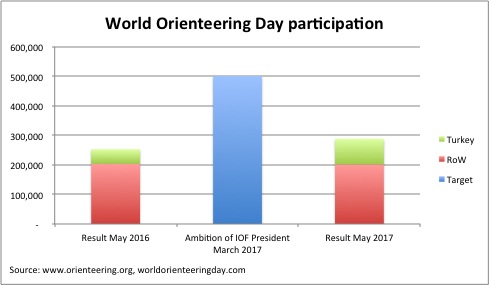
Last year the oversized ambition of the IOF leadership has fallen flat on its face as discussed earlier. Overall participation has increased thanks only to the unbelievably high numbers of Turkey. In fact, participation for the rest of the World has even decreased from 203,519 (2016) to 201,571 (2017). Far-far away from the declared ambition of the IOF President of 500,000 participants.
WOD participation 2016-17 v2

The 500,000 participation level dreamt up by the IOF leadership looked beyond reach even for 2018. They were desperate to find a solution. And they did!

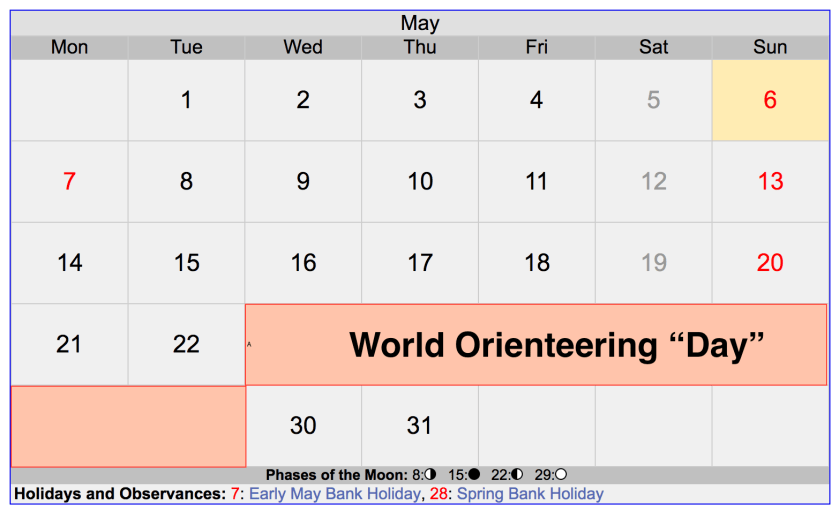
The Council has declared that World Orienteering Day in 2018 will start on 23 May and will last till 29 May. Stretching WOD over a week, but keeping the WOD name for continuity instead of introducing WOW, World Orienteering Week.
WOD calendar


There are good reasons to extend the event over a week instead of keeping it on a single day. In some countries it may be difficult to organise these types of school events during weekdays, in some others it may be difficult during weekends. It gives lot’s of flexibility to organisers to adapt the idea to the local environment while keeping the “urgency” element of an internationally coordinated event. But why shall one still call it a “Day” instead of a “Week”?

No particular reasons were given in the Council meeting minutes #185. It was simply declared that the branding of the event stays the same. After all it has a long-long brand history stretching over a grand total of two occasions.

The WOD slogan “Be part of something bigger” has acquired a completely new meaning.

Have you ever been part of a day that lasted for a week?

The only benefit one may think about is that this way the optics would be just perfect. Overwhelming participation on WOD 2018 compared to WOD 2017. The IOF target of 500 000 participants, at 5000 locations in 100 countries becomes quite achievable, especially when organisers encourage even “normal O-training” done anytime during the week to be declared as a WOD event. Anything goes, as long as they increase the headline number to achieve the President’s vision of 500,000.

One example is the recent email from the British Orienteering Federation sent to clubs explaining “Your club can simply be involved by tagging on the words ‘World Orienteering Day’ to fixtures planned to take place on Wednesday 23 May through to Wednesday 30 May 2018 on the fixtures list on the British Orienteering website“. No new activity is required. Just add the number of participants of events planned anyhow. It really starts to look like a pure accounting exercise to inflate the numbers irrespective of the content.

But this is not the end of this story…

Continue reading “WOD = WOW – a Stroke of Genius”

The (s)elected ones

Just a quick detour into the realm of social psychology as a follow up article to my previous post on IOF elections. It presents a possible explanation why some members of the Council feel themselves highly empowered in discussions with practitioners as “member of a body elected by the General Assembly” – despite the fact that simply being selected for nomination by their national federations almost guarantees an “elected” seat in the Council.

I have to admit that during my 4 years as chairman of the MTBO Commission I got rather annoyed by Council members a couple of times . In discussions with different IOF commissions, when they ran out of arguments they simply declared that they were the ones elected to lead the IOF, hence they are the ones to decide. In some cases the Council did not even bother asking questions from practitioners, but made decisions that caused predictable confusion amongst athletes and organisers. The argument was the same: the Council was elected to make decisions, so they do what they feel like.

How can educated people who were well aware of the “election process” (or lack of it) as described in my previous post behave as if they would have won the US Presidential elections?

Most Council members completely ignored the fact that simply being selected for nomination by their national federation, almost guaranteed being elected. This was most comical for the Council sitting for the period between 2014 and 2016. In 2014 all candidates were “elected” without any voting for the simple reason that the number of candidates was equal to the number of seats to be filled.

Recently I stumbled on the explanation. The members of the Council may have fallen victim of a psychological trap explained by Paul Piff in a TEDx presentation below. Being selected to a privileged, dominant position (even if it is done randomly) may alter the way one perceives the world, talks to people, or thinks about their own achievements.


The short summary: Paul Piff, an Assistant Professor Of UC Berkeley, shows a footage of a psychological experiment – a rigged 2 player monopoly game where they randomly pick one player to be the rich guy with additional privileges. The rich player starts with more money, gets two dices to roll, and gets double the income for completing a circuit. As the selected “rich” player inevitably start winning, they start to act more aggressive, play louder, eat more of the free pretzels, mock their opponent, keep talking about their money. After the game, when they are asked to reflect on their experience, they talk about their superior tactics and strategy, rather than acknowledging the huge advantage given at the start.

Continue reading “The (s)elected ones”

Our leaders are the finest men

This post is not another one about the ethics of the IOF, but about elections. The title comes from a classic American protest song of the 1960s by Tom Paxton.

Many, many moons ago, in high school, my English teacher used American protest songs to liven up his classes and to make us learn more than just proper grammar. His unorthodox methods eventually earned him even a CBE, but that is another story. These days when I think about the IOF I often recall Tom Paxton’s song about how children are taught to avoid questioning the status quo.

Tom Paxton saw the stability of the US political system a hindrance to progress and accountability. The stability built into the IOF governance system may well be a hindrance to the development and accountability in orienteering.

I learned our government must be strong
It’s always right and never wrong
Our leaders are the finest men
And we elect them again and again

You can find the original here on Youtube.

It seems that the current IOF governance system is a key component of the issues around the federation. The checks and balances that are supposed to ensure that the Council works for the general good in practice do not really work.

These include, but not limited to the following:

  • There is no control over the Council between the General Assemblies (i.e. on 729 days out of 730), thus the President and Council does what they want, including modifying GA decisions at will (the most obvious is the modification of the budget only months after approval – here and here )
  • There are no consequences for giving information to the General Assembly that may raise serious questions around its reliability (the 2016 financial status is probably the best documented one here)
  • There are no accountability for actions (or in some cases inactions) that could raise serious ethical questions in a more disciplined environment. (see here a few examples)

The contested elections would provide the ultimate checks and balances, but in practice they do not exist. Just the opposite: the IOF election system provides the stability for the Council to stay in place. There is stability derived from the low number of candidates, from the system, and the culture of Council itself.

Stability in the numbers

On paper the General Assembly elects the President and the Council, but in practice they have little choice. A few charts speak better that thousand words:

IOF Presidential election 2000-16

I do not have hard data from previous years, but nobody I spoke to could remember another occasion other than 2012 since 1961 (28 elections altogether) when the election of the president was contested.  Sorry to say, but President Putin and President Erdoğan have to face much more competition in their quest to retain their position. It seems that IOF Presidents stay in position unchallenged until they want.

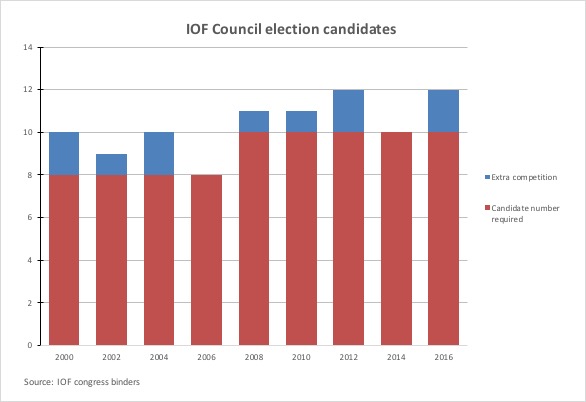
The number of candidates for Council positions is not much higher. In fact, the total choice offered over the last 9 elections is remarkably similar: 10 for 9 for president (11% extra) and 93 for 82 (13% extra to choose from) for Council positions.

IOF Council election 2000-16

(for simplicity I combined the number of candidates for vice president and council member, though they are elected separately)

The number of people actually facing election is far less due to low number of candidates and set quotas (at least 2 of each gender and at least 2 from outside Europe). In 2016 three people were “elected” with no competition. In 2014 the whole Council, all the eleven people, took their position with the General Assembly given the possibility other than to applaud them.

Funnily enough, the Council’s trump card in any discussion when they face arguments from the experts of support and discipline commissions is that they are the “elected body” to make decisions for the sport. Yes, elected for the lack of choice.

Continue reading “Our leaders are the finest men”

Ethics of the IOF

Ethics is a fascinating question, especially in amateur sport federations based on volunteer work, where the common values and beliefs are the most important glue holding together the organisation.

The newly formed Ethics Commission is working on the review of the IOF internal documents and on possible amendments from the point of view of ethical and other principles contained in the IOF Code of Ethics. They asked in a Request for Consultation all member federations and other stakeholders to submit thoughts, modification proposals or any other ideas concerning various IOF documents.

Yet, when it come to ethics, practice is what really matters. And practice can be very different from written rules. The very nature of ethics is that it is primarily driven by unwritten ethical standards and not by written rules. Some well known ethical standards that often override written rules include the ethics of old boys network (I scratch your back, you scratch mine), and the ethics of omerta (silence and non interference when somebody from the group steps over the line).

One problem is that it is difficult to describe unethical behaviour in a formal way. It is just like porn: it is difficult to define, but you know it when you see it.

The other problem is whether there is an enforcing mechanism, and leadership may not decide to look away for less than respectable reasons, like convenience or old friendship.

Let me share some of the stories from the past couple of years of the IOF that might raise questions around ethical approaches. As a former chairman of a discipline commission I was involved directly in a relatively limited set of IOF questions, but being around in the organisation I could observe many more.

I selected stories from the period of different Presidents to avoid the implication that these questions linked to certain leadership. The point is not to reopen these cases, but to illustrate real life situations that may occur within an amateur sports federation, situations some may raise ethical questions. Readers may decide whether they “see it or not”.

  • The career of the secretary
  • A three quarters majority applause
  • Cui bono?
  • Respect of the rules
  • A dream budget
  • An open and honest discussion

For readability and to ensure focus on the core question these stories were somewhat condensed, but ample background information is available to expand them.

This is a longer than usual post. It may be too dense to read it through in one go. But I think that keeping these stories in one bouquet may help readers to understand that they appear to be more than random individual cases. I also wanted to give examples from the reign of different presidents to show that these are not personal questions.

One may also recognise patterns, and may even be forgiven to come to the feeling that not written rules, but the ethics of a good old boy network, and the ethics of silence govern conduct in sensitive matters within the IOF.

Continue reading “Ethics of the IOF”

Critical to Quality – Talk vs Action – Part 2

On 7 December the President of the IOF has published his thoughts on matters critical to quality of major events. These were refreshing thoughts, albeit somewhat unexpected, that emphasised core qualities of orienteering events like quality of maps and course setting.

“For me, CTQ at IOF major events are maps, course setting, punching and timekeeping. Of course, there are also important areas like event arenas, logistics, accommodation, ceremonies etc. at big events. But if we fail in CTQ areas, the event will be remembered forever!”

For a moment one could hope that the IOF leadership has realised what are the things organisers should focus on when staging major international orienteering events.

Yet, when we try to match the words of the President with the obligations put on organisers by the IOF, we see a mammoth gap between the two.

Mismatch between talk and action is not alien to the IOF leadership as I showed in the post about the 2024 Olympic ambitions. This is the second part of the talk vs action series.

Below I show some examples of mismatch based on the IOF Event Application documents released late 2017. That was about the time when the wise words of the President were published. Unfortunately, neither the detailed formal evaluation of applicants, nor the explicit and often contractual obligations match the words of the President.

That is really pity. In case of organisations, especially of organisations built on the effort of volunteers, matching words and actions is the single most critical feature of leadership quality.

Continue reading “Critical to Quality – Talk vs Action – Part 2”

The Agency Problem – Part 1

A case that may both demonstrate the reason for budget overruns and the general lack of controls within the IOF is the story when Brian Porteous, the President at the time, decided (apparently single handedly) to spend money over the anyhow loss making IOF budget on the SportAccord convention in 2013.

Brian decided to ignore the 2013 budget that was approved in July 2012, just 6 months before. A budget that he himself proposed as Vice President at the time of budget preparation.

The Council members, according to the Council minutes, did not blink, as in many other cases when the President made interesting decisions. The member federations had no meaningful mechanism to react.

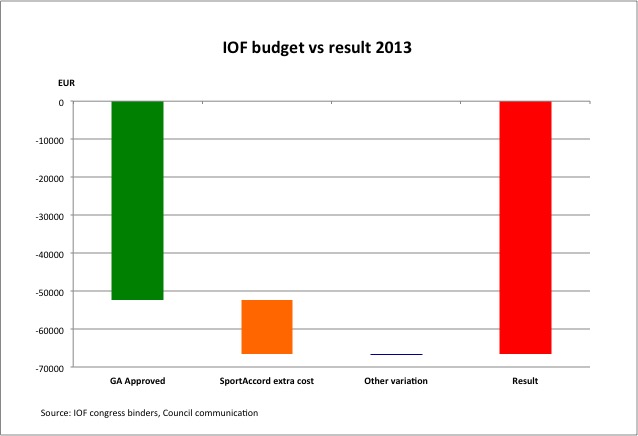
As a result of the extra €14,100 spent on the SportAccord Convention the budgeted loss  of €52,400 for 2013 has become a loss of €66,600.  There was still some reserves left to spend.

IOF Budget 2013

Before we get into details of this story, I think that it would be useful to introduce some theoretical background.

The Agency Problem

The core issue around the IOF is what business literature calls the Agency Problem. This is an unavoidable feature of large organisations where owners  (shareholders, or in our case 70 member federations) entrust an agent (CEO/President, Board/Council) to run the organization on their behalf.  Unavoidably, the two parties will have different interest and the agent will run the organization in a way that is not optimal for the owners. Conflict of interests and moral hazards are frequent problems. The lost value to the owners is called the Agency Cost.

Continue reading “The Agency Problem – Part 1”

Ten Years of Underperformance – Update

Over the past month I was too busy to deal with much more entertaining things than documenting the mismanagement and slow motion crash of the IOF. But now I have some time to continue with this gruesome task.

The Council had a meeting on 13-14 October. The published minutes (#186 here) provide additional information and data on the Council attitude to IOF finances.

The Council minute looks like a good old Soviet party communique: all good news, as long as you do not scratch the surface. It reinforces the feeling that the IOF leadership considers finances as their little internal business members should not get involved in.

The 19 page long minutes do not even mention the IOF – Letter to members July 2017 sent by the IOF President after the last Council meeting. The one that was carefully sent after the Presidents’ Conference regarding financial issues and the major revision of the budget. It was a “no event” that the IOF leadership apparently prefer to forget about and erase it from publicly documented history.

The key message of the minutes that revenues are up and expected to rise, while costs are largely under control. The funny bit is that the additional costs mentioned (regional event medals, higher overseas event advising costs, SEA for the World Games) are ones that should have been known when the 2017 budget was prepared. The fact that IOF Leadership uses them as an excuse for higher costs just underlines the feeling that the 2017 budget submitted to the General Assembly for approval was – mildly speaking – not thought through.

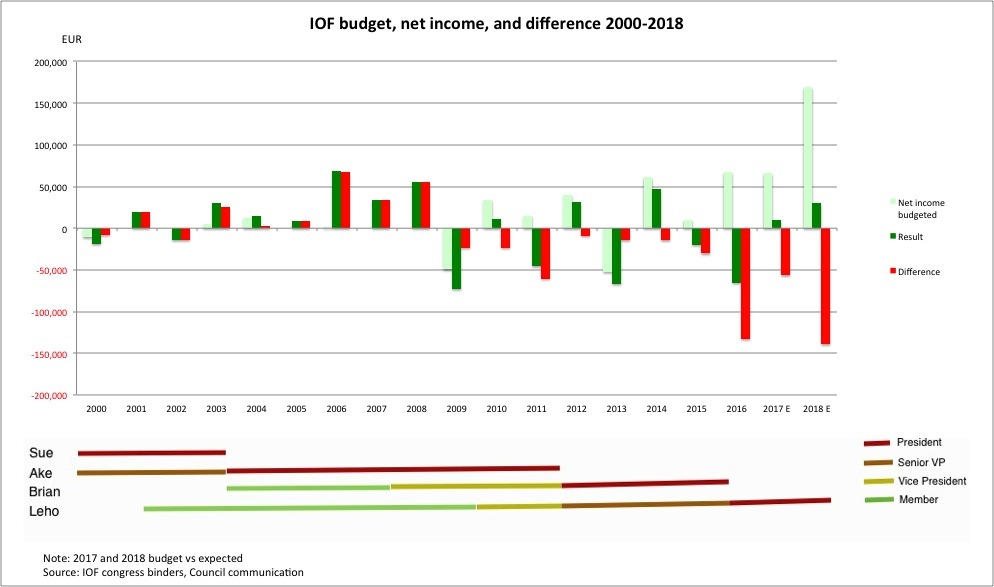
Yet, with all the improvements 2017 is still expected to show only a small positive result estimated at around €9,000 (85% below the €66,000 budget), and the updated forecast for 2018 was €30,000, that is over 80% lower than the €169,000 presented to the General Assembly. As expected, the GA approved original budget numbers were carefully not mentioned in the Council minutes.

Now it is official that Council expects to underperform their own budget by a 10 year combined gap of over €500,000 as a result of not meeting their own targets in any year since 2009.

IOF Net income vs budget - update

It is also interesting to zoom in the (2016-18) budgets presented to the General Assembly 2016. The gap between Council promises and delivered results has exploded.

Continue reading “Ten Years of Underperformance – Update”

Ten Years of Underperformance – Skill or Will or Something Else?

The decade long erosion of the financial stability of the IOF discussed in the previous post did not come as a result of a sudden event. It was the result of continuing underperformance of the IOF leadership who missed the budget target for 10 years in a row.

Please see updated numbers to this post here.

This post has turned out to be longer than expected. I had little time to write it, so I could not make it shorter. Here is the summary if you are also pressed on time:

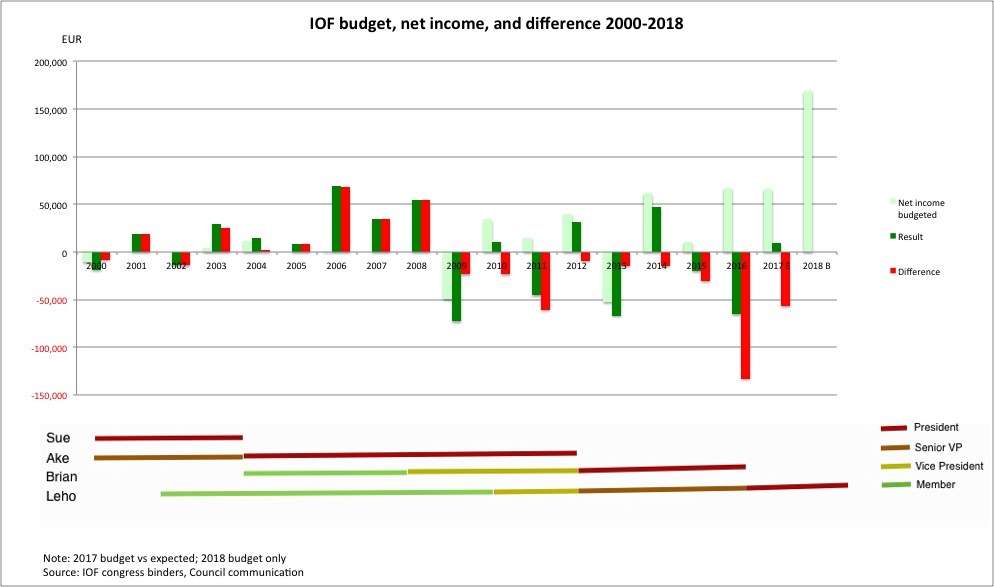
  • The IOF Council has missed the budget target every year since 2009. The target set by themselves, and rubberstamped by the General Assembly without change.  It would take a miracle to achieve the targets for 2017 and 2018. That makes 10 years of missed targets. 10 years of continuous underperformance.
  • It is unlikely that this was due to lack of skills: the leading figures of the IOF during this period (Ake, Brian and Leho) all prided themselves with business background.
  • Looking at recent events one may get a feeling that the IOF leadership just did not care about the budget approved by the GA, hence they could not possibly deliver it:
    • In a letter to member federations about the difficult financial status of the IOF signed by Leho and Tom, the “GA Budget 2017” is different from the 2017 budget published as approved on the IOF website in the minutes of GA 2016.
    • In the same letter they claim that in October 2016, 2 months after presenting the 2017 budget to the GA, they already started to modify it “to get costs in line with expected income”. There was not a hint of an unexpected event that could have modified expected income in the 2 months after the GA. This gives the feeling that the Council presented a 2017 budget to the GA that was not realistic, but the GA approval gave the Council free hand to modify it to their liking.
    • The outcome of budget modification(s) started in October 2016 was not shared with member federations until 14 July 2017, nine days after the  Presidents’ Conference in Tartu. This gives the feeling that the IOF leadership decided to avoid any open discussion about budget modification with the member federations who approve the IOF budget.

Here are the details of the story that may make you wonder how long IOF member federations will put up with being treated like this.

The numbers

The Council missed their own target every year since 2009, for 8 consecutive years. They already conceded that 2017 will be missed (€66,235 surplus was budgeted, but only €9,767 was expected in July 2017). It looks also highly unlikely, that in 2018 the budgeted €169,010 surplus, that is 2.5 times(!) higher than ever achieved in the IOF’s 56 year history, will be delivered. That gives a solid 10 consecutive years of missing the budget as shown on the chart below.

For updated data please see this post published after the October 2017 Council meeting. 

IOF Net income vs budget v2


This level of  underperformance is most remarkable under any circumstances. It is even more remarkable, because
a) the IOF was run by experienced managers according to their CV, and
b) the budget was set by the Council themselves, only rubber stamped by the General Assembly.

Officially it is the General Assembly who sets the budget, but in practice it simply approves the one submitted by the Council. I could not find a case in recent memory when the GA modified the budget. I could not even find a case in recent memory when the GA has even debated a line item. There were some high level remarks now and then, but everything was approved as suggested by the Council. So we are not talking about some stretch targets not being met. No, simply the IOF leadership could not deliver for 10 consecutive years on their own promises made with no external pressure. Remarkable.

Skill or Will?

Seeing this level of underperformance one should ask whether it was due to missing skill or missing will. Could it happen that the leadership of the IOF did not have the basic skills required to prepare and deliver a budget for a quite simple small operation? Or was it due to lack of motivation or intention to deliver on their promises, and follow the budget approved by the General Assembly? Or was there something else behind all this?

Let’s try to find some pointers that may help us decide.

Continue reading “Ten Years of Underperformance – Skill or Will or Something Else?”

IOF Council attitudes – some data

I wrote my last post about the World Game accident in anger. For me it was just another unfortunate outcome of the Olympic and ceremony biased attitudes of the IOF Council I saw over the past six years. Some people less familiar with the workings of the Council – as I was myself before I was requested to join the MTBO Commission – told me that there was no real substance in that post, only emotions.

I fully appreciate that things that are obvious for me about the workings of the Council, may not be obvious for others. So I decided to compile some data to illustrate my point about the things the Council is interested in, and about the ones they are not bothered with. I have to admit, that despite having no high expectations, I was astonished by the results.

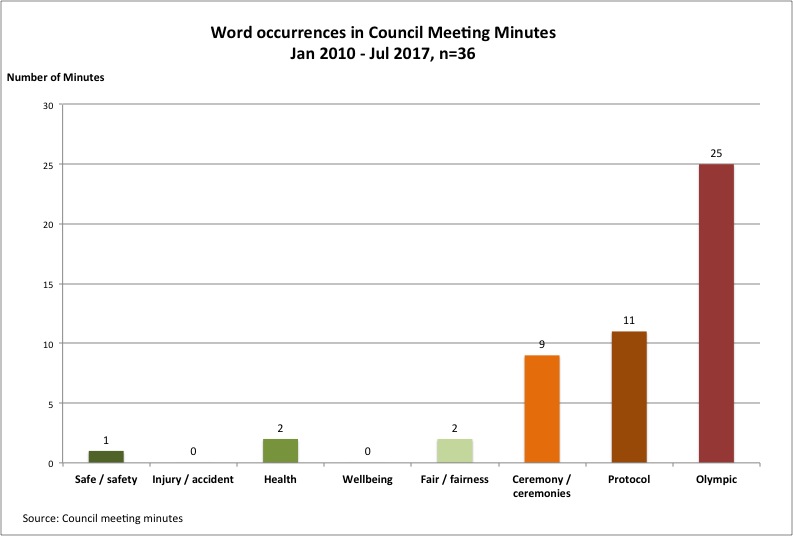
The number of Council meetings since 2010 where ceremonies were discussed was almost two times higher than the combined number of meetings where safety, accidents, injuries, athletes health and wellbeing, or competition fairness was mentioned.

This appears to be in stark contrast with the Ethical Principles of the IOF declared in the IOF Code of Ethics:

“In pursuing the sport’s goals, the governance of Orienteering shall be mindful of the physical and psychological wellbeing of its athletes.”

I used the Council meeting minutes as a proxy to the mindfulness of the Council. Few people read them, but they reflect quite well the topics the Council is dealing with. These are fairly detailed accounts of 2 to 3 day long Council meetings. Typically they are 6 to 12 pages long, though there are 4 page and 21 page long ones too. They are available on the IOF website for the periods of July 1996 to August 2003, and January 2010 to present. The ones after January 2010 (#150) are searchable. So I could easily search 36 of them spanning over 7 and a half years till today (#150-185).

Below is the summary of the number of Council minutes that contained certain key words. I counted only the occurrences with substance, as detailed below.

Council meeting minute statistics v2

I think these results speak for themselves to prove that the IOF Council does not appear to be mindful of the physical and psychological wellbeing of its athletes, both in absolute terms, and especially relative to the attention given to protocol, ceremonies, and the Olympic Dream.

See details below:

Continue reading “IOF Council attitudes – some data”

The World Games – what shall we call this?

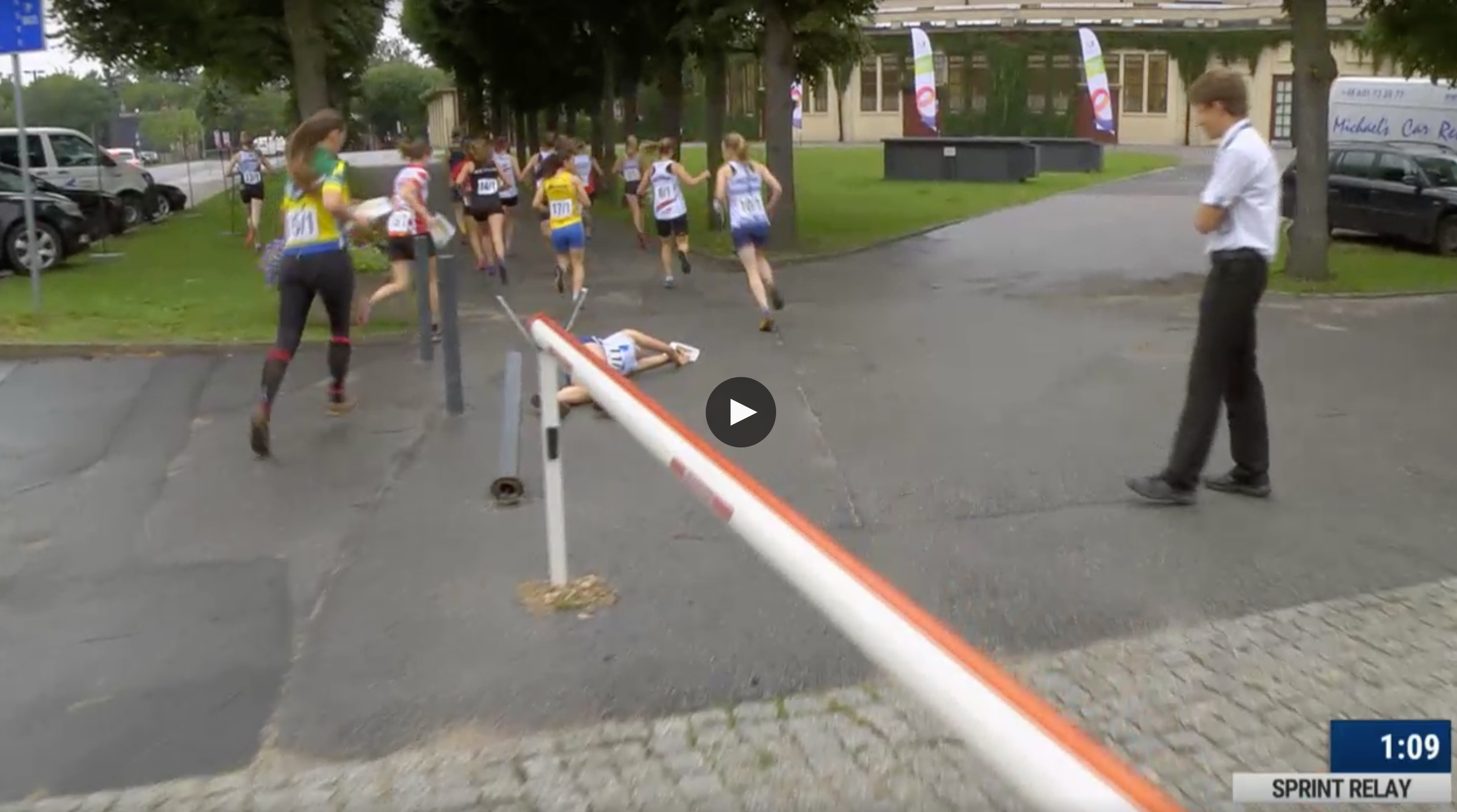
I am lost for words. I really feel for poor Isia, the first runner of the French team on today’s Sprint Relay. I hope her injuries are not too bad, and she was lucky enough to avoid serious consequences of a situation that could have ended in a very, very bad way.

TWG Sprint Relay - French team

You can watch the video here at 25:50.

200m from the start, 15m from the map start, when everybody is in one bunch with heads down trying to make sense of the map. Barrier, thin grey bollards with sharp edges, concrete flower bed. It is a loose-loose situation in every sense.

The showcase for orienteering, two IOF advisers, LiveOrienteering coverage, full attention of the Leadership, special article from the President on the importance of The World Games on our way to the Olympics.

All the IOF focus – except for basic athletes’ safety.

Orienteering is inherently risky. You cannot make it risk free. Part of the joy is that you take on calculated risk – not only in route choice, but also in personal safety. I know this very well having involved in orienteering for over 35 years, and in MTBO – the riskiest of all disciplines – for over 10 years.

But we should do our best that athletes take on only the risk they want. They should not be exposed to unexpected hazards they are not prepared for. They should be warned, they should be routed around, organisers shall take care of the athletes at all levels. In MTBO we created an online injury database to collect data and experiences, and safety aspects especially around start and finish are regularly revisited with organisers and in Event Adviser clinics.

Here is the point where top management talk matters. Two decades of working with top managers and being in top management myself taught me that it matters much more than people in position imagine.

When all the top management talk is about high flying ambitions, attractiveness, TV production, and dignified ceremonies just like in the Olympics – it focuses the mind of organisers in one way. When there is also talk about athletes’ safety, it helps tremendously to avoid mishaps like the one we saw today.

I hate to write about this today.